Jio Platforms IPO in Numbers: Price Band, Lot Size, Valuation and What the Filing Shows
Jio Platforms IPO opens 21 Oct: ₹1,065 to ₹1,119 band, 12-share lot, ₹30,213 crore size. See financials, valuation vs Airtel, risks and past mega-IPO results.
₹30,213 crore. 27 crore new shares. A 12-share lot that costs ₹13,428 at the top of the band. On Wednesday 21 October, Jio Platforms opens India's biggest-ever IPO, about 8% larger than Hyundai India's record of ₹27,859 crore.
Everyone has a view on it. Few have the numbers in one place. This guide pulls together the price band, the lot maths, where the money goes, the financials, the valuation against Airtel, the risks, and what happened to the biggest IPOs before it. It does not tell you to apply or avoid. It tells you what the filing says.
Written on 19 October 2026 from the offer documents as reported by secondary sources (Chittorgarh, Groww, Business Today, HDFC Sky, Angel One). We could not open the red herring prospectus (RHP) itself, so please verify the headline numbers there before acting. Educational content, not a recommendation to apply for or avoid the IPO.
- Price band ₹1,065 to ₹1,119. The issue is 100% fresh shares (27 crore), worth ₹30,213 crore at the top. No existing holder is selling. It opens 21 October and closes 23 October.
- One lot is 12 shares: ₹13,428 at the top of the band. A retail investor can bid up to 14 lots (168 shares, ₹1,87,992). A 15th lot (₹2,01,420) tips the application into the non-institutional category.
- At the top of the band, Jio is valued at about ₹10.30 lakh crore (about $107 to 108 billion), roughly 87% of Bharti Airtel's market value of ₹11.8 lakh crore. Reliance Industries' 64.5% stake after the issue is worth about ₹6.6 lakh crore, about 40% of Reliance's own market value.
- Around 91% of the proceeds (₹27,500 crore) go to repaying borrowings. Jio's net debt was ₹27,579 crore at March 2026, or 0.36 times EBITDA, but that excludes about ₹1.05 lakh crore of deferred spectrum dues.
- FY26: revenue ₹1,46,885 crore (up 14.6%), EBITDA ₹76,255 crore (52% margin), profit ₹30,049 crore. Spending fell from ₹53,510 crore in FY24 to ₹34,184 crore in FY26, so EBITDA minus capex rose from ₹1.4k crore to ₹42.1k crore.
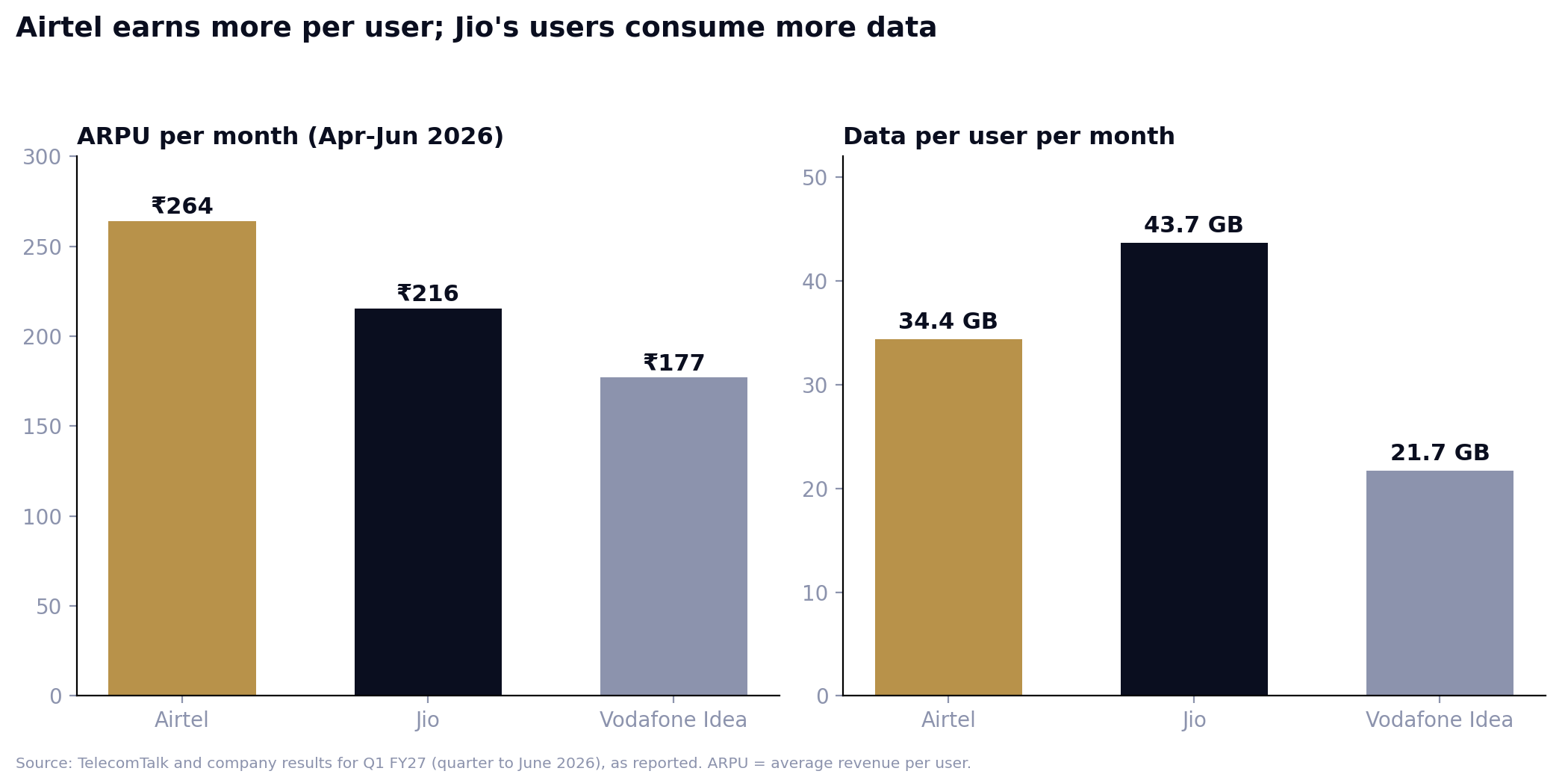
- At the top of the band the price is about 33 to 34 times FY26 earnings, against about 34 to 41 times for Airtel (sources differ). Airtel earns more per user (₹264 against ₹216) and has a higher return on capital (19.1% against 10.8%).
- Of the eight biggest IPOs we could track, five rose on listing day, but only three trade above their issue price today. Listing day is not the finish line.
- The 'grey market premium' (about ₹250 on 19 October) is unofficial and unverifiable. We show it as a data point, not a signal.
The offer at a glance
| Item | Detail |
|---|---|
| Company | Jio Platforms Ltd (parent of Reliance Jio Infocomm and Jio's digital businesses) |
| Price band | ₹1,065 to ₹1,119 per share (face value ₹10) |
| Issue structure | 100% fresh issue of 27,00,00,000 shares; no offer for sale |
| Issue size | ₹30,213 crore at the top (₹28,755 crore at the floor) |
| Share of post-issue equity | 2.93% (post-issue shares: 9,20,90,30,830) |
| Lot size | 12 shares: ₹12,780 at the floor, ₹13,428 at the top |
| Anchor bidding | 19 October (reported demand over $20 billion in bids; allotment list not yet published) |
| Issue opens / closes | Wednesday 21 October / Friday 23 October |
| Allotment, refund, listing (tentative) | About 26 October, 27 October and 28 October on BSE and NSE |
| Category split | Qualified institutions up to 50%; non-institutional at least 15%; retail at least 35% |
| Employee reservation | Up to ₹500 crore, with a ₹54-per-share discount |
| Reliance shareholder reservation | Up to ₹2,500 crore, no discount, up to ₹2 lakh per applicant |
| Registrar | KFin Technologies |
| Lead managers | 19 banks including Kotak Mahindra Capital, Morgan Stanley, BofA, Axis, BNP Paribas, Citi, Goldman Sachs, JP Morgan and SBI Capital Markets |
Sources: Chittorgarh, Business Today, Angel One, HDFC Sky (RHP filed 14 Oct 2026 as reported). Dates are tentative until confirmed by the exchanges.
How big is big?
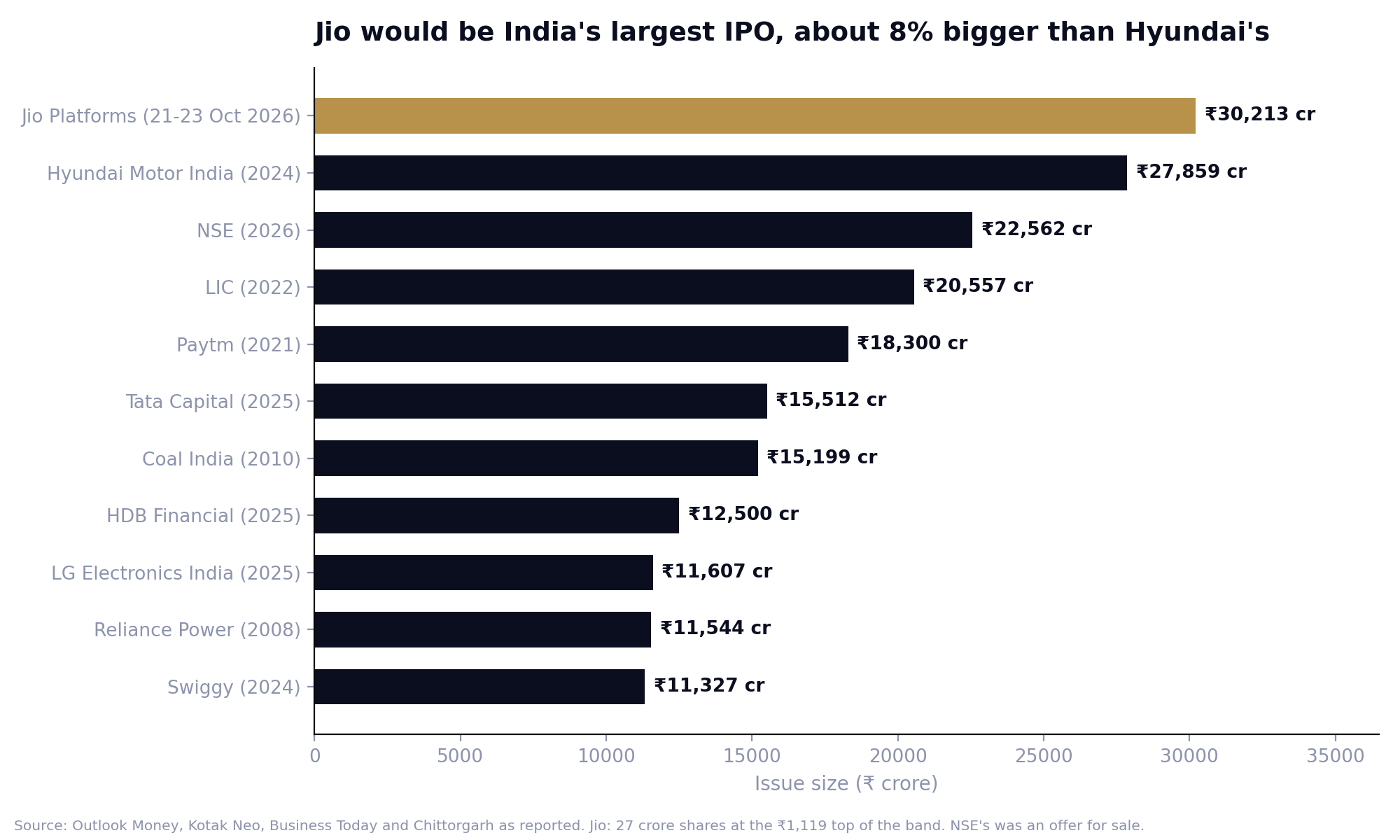
At ₹30,213 crore, Jio would be about 8.4% larger than Hyundai India (₹27,859 crore) and about 47% larger than LIC (₹20,557 crore). Yet it sells only 2.93% of the company, which is why the cheque is so large: at the top of the band the whole of Jio Platforms is valued at ₹10.30 lakh crore, about $107 to $108 billion. Earlier talk of $170 billion, and a July estimate near ₹11 lakh crore, did not survive the price band.
Put that in context with two listed companies. Bharti Airtel's market value is about ₹11.8 lakh crore, so Jio at the top of the band is about 87% of it. And Reliance Industries, worth about ₹16.5 lakh crore, would own 64.48% of Jio after the issue, a stake worth about ₹6.6 lakh crore. By our arithmetic, about 40% of Reliance's market value is Jio.
What would a bid look like?
| Lots | Shares | Amount at the top of the band (₹1,119) | Category |
|---|---|---|---|
| 1 | 12 | ₹13,428 | Retail |
| 5 | 60 | ₹67,140 | Retail |
| 10 | 120 | ₹1,34,280 | Retail |
| 14 | 168 | ₹1,87,992 | Retail (the maximum) |
| 15 | 180 | ₹2,01,420 | Non-institutional (small) |
| 75 | 900 | ₹10,07,100 | Non-institutional (big) |
Retail bids are capped at ₹2 lakh. Small non-institutional bids run from 15 to 74 lots (about ₹2.01 to ₹9.94 lakh); big ones from 75 lots. Retail, employee and shareholder bidders may bid at the cut-off price; non-institutional bidders may not. Source: Chittorgarh (RHP details).
The retail portion is at least 35% of the net issue, which we estimate at about ₹9,525 crore, or roughly 71 lakh lots at the top of the band. The Reliance shareholder reservation of ₹2,500 crore is about 18.6 lakh lots. These are our estimates from the stated quotas.
How allotment works if the retail portion is oversubscribed
When applications exceed the lots available, allotment to retail applicants is made by lottery of one lot each. As an illustration only: if the retail portion were subscribed 5 times, roughly one in five valid applications would get a lot, and at 20 times, roughly one in twenty. Applying for more lots does not raise your chance of getting a lot. Subscription figures will only be known when the issue closes on 23 October.
Who counts as a Reliance shareholder?
The reserved portion is for individuals and HUFs who held at least one Reliance Industries share in demat on the record date, reported as 14 October (outlets differ by a day, so check the RHP). PAN details must match, and Jio Financial shares do not count. Eligible shareholders can also bid in the retail or other categories, and this is not treated as a multiple bid.
The process
- Bids are placed through UPI, ASBA or a broker. Under general SEBI rules, bids up to ₹5 lakh can use a UPI mandate.
- Allotment is expected on about 26 October, refunds and demat credit on about 27 October, and listing on about 28 October.
- Allotment status can be checked on the registrar's portal (KFin Technologies) or on the BSE and NSE allotment pages.
Where the money goes
Because the issue is entirely fresh shares, the money goes to the company, not to existing holders. About ₹27,500 crore (91% of the issue) is earmarked for prepaying or repaying borrowings of its material subsidiary Reliance Jio Infocomm, and the balance is for general corporate purposes. Reported capital spending and spectrum payments are not objects of the issue.
That matters for the balance sheet. Total borrowings were ₹70,781 crore at March 2026 and ₹61,372 crore at June 2026. Net debt, by the company's definition, was ₹27,579 crore at March 2026 (0.36 times EBITDA) and about ₹9,539 crore at June 2026. But the definition excludes deferred spectrum liabilities of about ₹1.05 lakh crore and lease liabilities (₹12,168 crore at June), so net debt is not the whole picture.
The financials
| ₹ crore | FY24 | FY25 | FY26 | Q1 FY27 (Apr to Jun 2026) |
|---|---|---|---|---|
| Revenue from operations | 1,09,558 | 1,28,218 | 1,46,885 (+14.6%) | 39,173 (+11.8% YoY) |
| EBITDA | 54,959 | 64,170 | 76,255 (+18.8%) | 20,865 (+15.1% YoY) |
| EBITDA margin | about 50.2% | 50.1% | 51.9% | 53.3% |
| Profit after tax | about 21,430 | about 26,110 | about 30,050 (+15%) | 7,764 (+9.2% YoY) |
| Cash capex | 53,510 | 44,268 | 34,184 | about 4,184 |
| Total borrowings | 54,349 | 73,060 | 70,781 | 61,372 |
| Net worth | 2,77,866 | 3,04,022 | 3,34,013 | 3,41,779 |
Source: restated consolidated financials from the DRHP/RHP as reported (Chittorgarh, Groww, HDFC Sky, TelecomLead). Profit is shown in two slightly different sets in different outlets (for example ₹30,049 crore and ₹30,053 crore for FY26); we show an approximate figure.
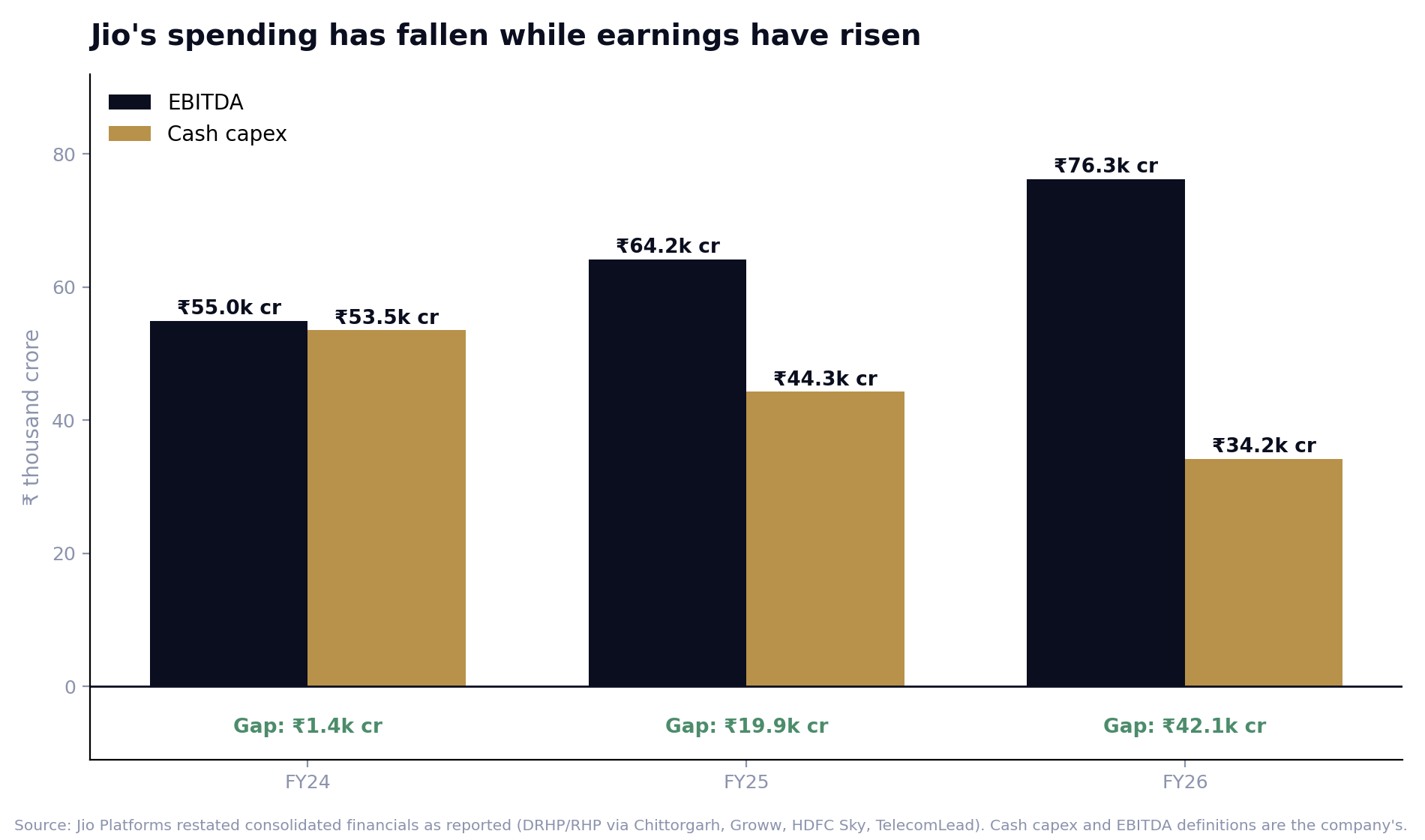
Three numbers stand out. EBITDA margin rose from about 50% to 53% in two years. Capital spending fell from 48.8% of revenue in FY24 to 23.3% in FY26, which lifted EBITDA minus capex from about ₹1.4k crore to ₹42.1k crore. And return on equity is only 9.4% (FY26) with return on capital employed of 10.8%, which reflects a very large asset base.
Growth is also slowing a little: revenue grew 14.6% in FY26 but 11.8% in April to June, and profit growth eased from 15% to 9.2%. The last broad tariff increase was in July 2024. Brokerages expect another (Motilal Oswal assumes about 15% in December 2026), but those are forecasts, not facts.
Jio versus Airtel: the operating numbers
| Metric (latest) | Jio | Airtel | Note |
|---|---|---|---|
| Subscribers | 533 million (Jun 2026) | about 490 million (India) | Airtel also has about 188 million in Africa |
| 5G users | about 285 million | n/a | Jio's 5G subscribers |
| ARPU per month (Apr to Jun 2026) | ₹215.6 | ₹264 | Vodafone Idea ₹177 |
| Data per user per month | 43.7 GB | 34.4 GB | Vodafone Idea 21.7 GB |
| Active mobile subscriber share (Aug 2026) | 41.7% (43.2% a year earlier) | 40.3% (33.6% a year earlier) | Airtel is gaining share on this measure |
| Fixed broadband and wireless | 28.6 million connections; AirFiber over 14 million | n/a | Jio claims about 43% of fixed broadband |
| Return on capital employed | 10.8% (FY26) | 19.1% | As reported by Business Today |
Sources: company results and TelecomTalk (Q1 FY27), TRAI data via press, Business Today. Different outlets use different measures for market share.
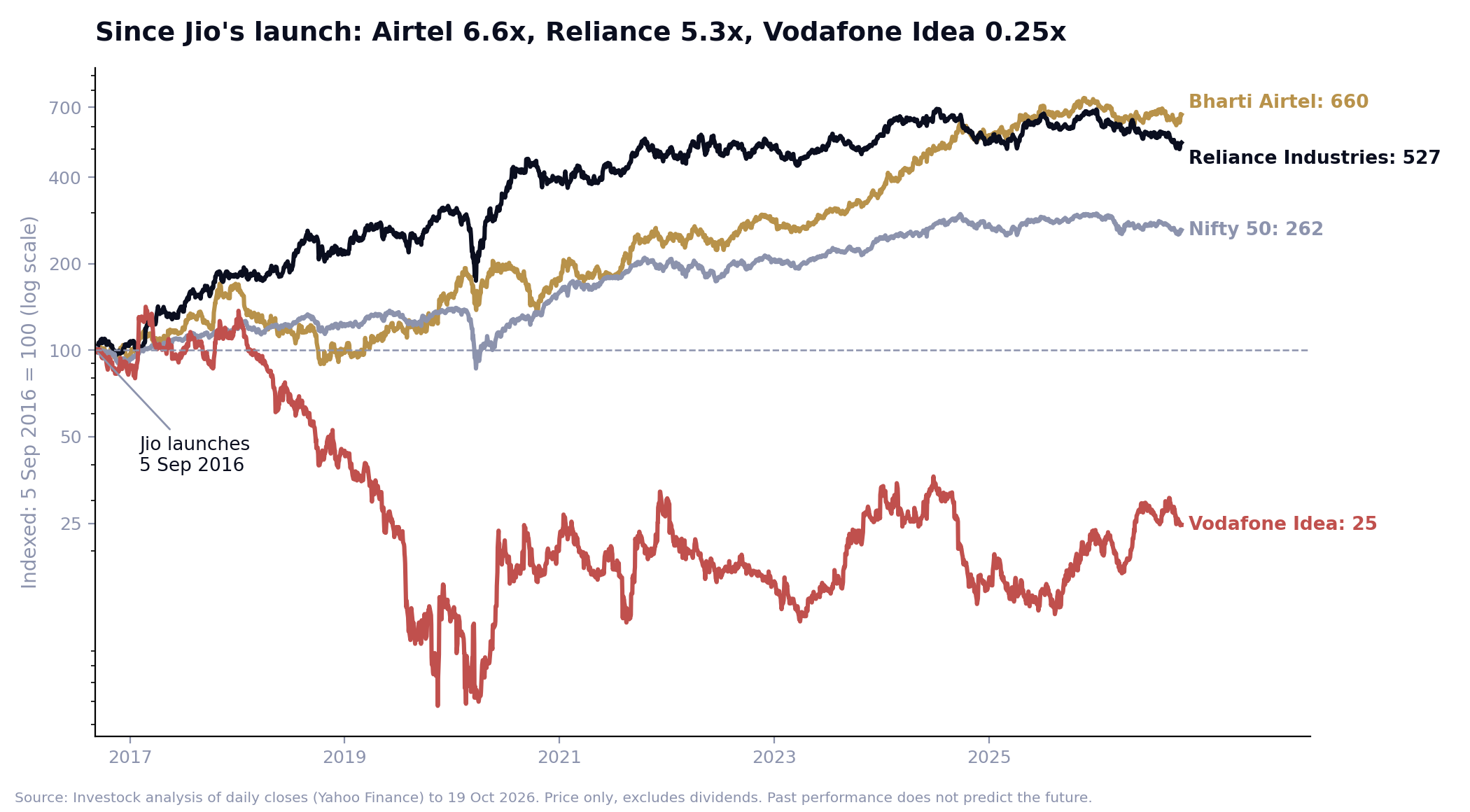
The long view is striking. Since Jio's commercial launch on 5 September 2016, Airtel's share price is up 6.6 times, Reliance's 5.3 times and the Nifty 50's 2.6 times (price only, no dividends), while Vodafone Idea has fallen to a quarter of its price. This year has been harder: Reliance is down about 22% for 2026 and Airtel about 10%, against about 12% for the Nifty.
Valuation: what the price implies
| Measure | Jio at the top of the band | Bharti Airtel | Basis |
|---|---|---|---|
| Market value | ₹10.30 lakh crore (about $107 to 108 bn) | about ₹11.8 lakh crore | Airtel at 19 Oct price |
| Price to earnings (FY26) | about 33x to 34x | about 34x to 41x | Airtel's figure differs by source |
| Price to book | about 3.0x | n/a | Jio: ₹373.66 book value per share (Mar 2026) |
| EV to EBITDA | 10.5x to 15.6x depending on broker and year; our own estimate is about 13.9x FY26 (excluding spectrum dues) | about 9.2x to 10.3x (India business, FY28E) | Bases differ; do not compare across rows |
| Return on capital employed | 10.8% | 19.1% | FY26 |
Sources: Chittorgarh, Business Today, brokerage notes as reported (Emkay, Motilal Oswal, Nomura, Swastika, Arihant). Our EV figure is market value plus company-defined net debt of ₹27,579 crore, divided by FY26 EBITDA of ₹76,255 crore. Multiples vary with the EV definition and the year used, so always check the basis.
The ownership table after the issue: Reliance Industries would hold 64.48% (from 66.43%), Meta about 9.7%, Google about 7.5%, and the public 35.52%. Since no existing holder is selling, ownership is diluted only by the 2.93% of new shares.
What history says about giant IPOs
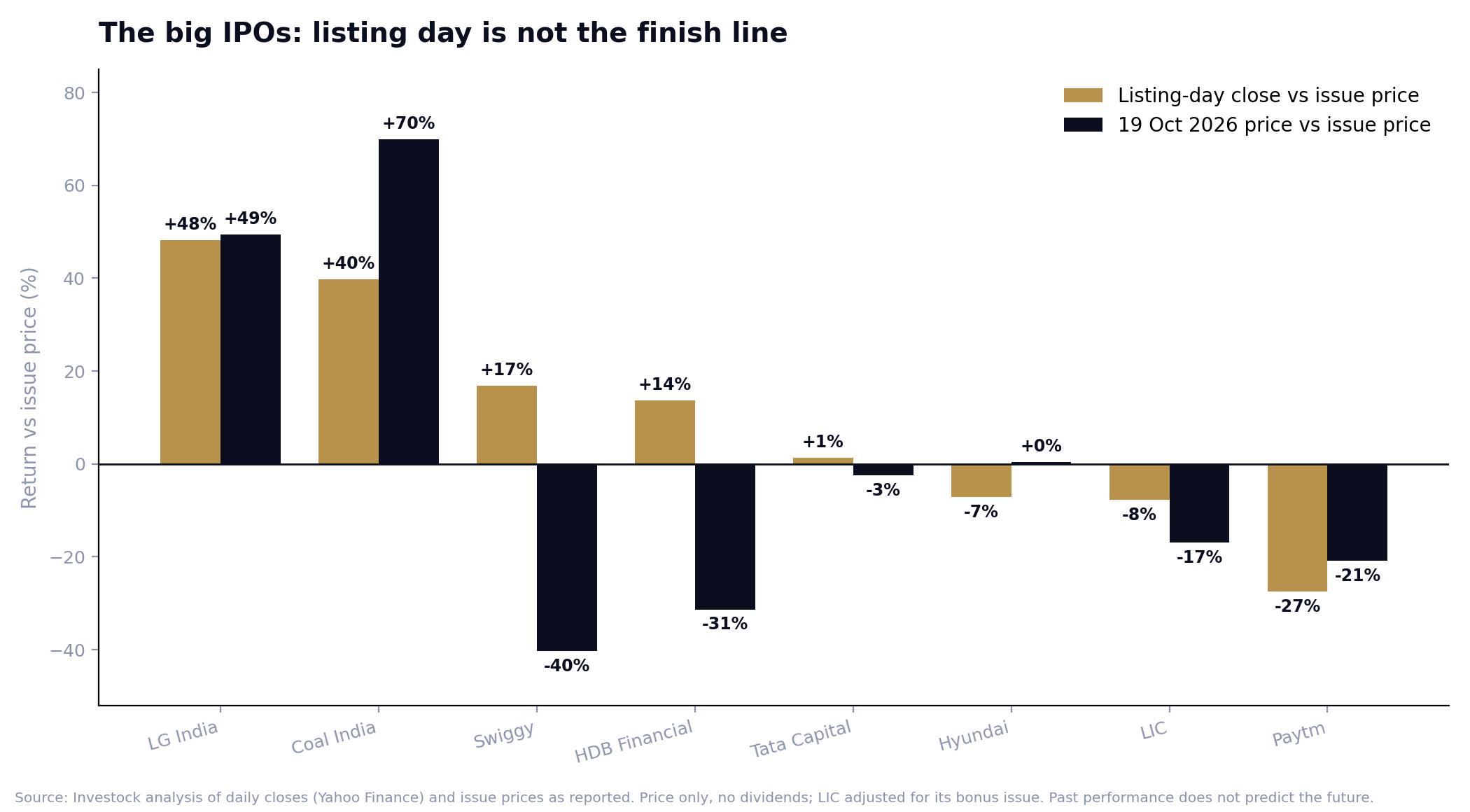
Of the eight biggest IPOs for which we have price history, five closed above their issue price on the first day (LG India +48%, Coal India +40%, Swiggy +17%, HDB Financial +14%, Tata Capital +1%) and three closed below (Hyundai -7%, LIC -8%, Paytm -27%). But today only three of the eight are above their issue price. Swiggy, up 17% on day one, is about 40% below its issue price today, and HDB Financial, up 14% on day one, is about 31% below.
The 'grey market premium' is the unofficial, unregulated price at which Jio shares are said to trade before listing. Reported figures were about ₹148 on 4 October, ₹225 on 16 October and about ₹250 on 19 October (about 22% of the top of the band). It is not an official price and its record is mixed: coverage of the NSE IPO reports a premium that fell from ₹285 to ₹45 before the stock listed about 1% above its issue price. We do not use it as a signal.
The risks listed in the filing
- Dependence on the Reliance group: Reliance Jio Infocomm contributed 87.74% of FY26 revenue, and Reliance Retail is the sole distributor of prepaid services. Prepaid was about 77% of revenue. Related-party dealings are described as arm's length.
- Spectrum and licence: the unified licence is due for renewal in 2033, and most spectrum expires within about 16 years (average remaining life 15.8 years). Deferred spectrum payments of about ₹1.05 lakh crore remain.
- Debt: borrowings of ₹70,781 crore at March 2026 (₹61,372 crore at June), with foreign-currency exposure.
- Competition and technology: satellite broadband, price competition affecting ARPU and churn, and technology obsolescence.
- Infrastructure: a tower company, Summit Digitel, owns 48.4% of the 360,382 towers Jio uses.
- Tax disputes: about ₹10,836 crore in claims against subsidiaries and ₹44,187 crore against the promoter, as reported.
- Regulation: 17 TRAI orders between April 2020 and June 2024 with financial disincentives totalling ₹27.1 crore.
Risk-factor summaries here come from press coverage of the DRHP and RHP, so check the exact wording in the prospectus.
What brokerages say, and how to read it
Among the views we found, about nine brokerages lean 'subscribe' for the long term and none say 'avoid'. Several argue Jio's multiple is below Airtel's on earnings, while others flag Airtel's higher return on capital and ARPU. Two houses gave no rating. Treat these as third-party opinions published before the issue opened, not as ours, and note that the lead managers themselves do not publish ratings.
How the market has reacted so far
Since the price band was announced, Reliance Industries is up about 4.6% (from 13 to 19 October) and Bharti Airtel about 5.0%, against about 1.5% for the Nifty 50. Reliance gained about 3.4% on 15 October, the day after the price band was announced and its strongest day in over two months. Airtel rose about 3.3% on 15 October and 2.8% on 16 October. Press commentary linked Airtel's rise to hopes that Jio's listing could ease tariff competition and to reports of an Airtel postpaid price increase (single source), but these are explanations, not proven causes.
What we do not know yet
- The anchor book: who got shares and how many, and any lock-in dates for anchors, promoters and pre-IPO holders. Not published at the time of writing.
- Index inclusion: we found no NSE, BSE, MSCI or FTSE announcement and no estimate of passive buying.
- The July to September quarter: Jio's Q2 FY27 results and ARPU are not yet out. Airtel's are expected around 5 November.
- Final subscription numbers, the cut-off price and the listing date and price.
Key dates
| Date | Event |
|---|---|
| Mon 19 Oct | Anchor bidding |
| Wed 21 Oct | Issue opens |
| Fri 23 Oct | Issue closes |
| About Mon 26 Oct | Basis of allotment |
| About Tue 27 Oct | Refunds and demat credit |
| About Wed 28 Oct | Listing on BSE and NSE (tentative) |
Dates as reported from the RHP coverage; confirm with the exchanges and the registrar.
How Investock thinks about a day like this
We do not tell anyone to apply for or avoid an IPO. A single, very large issue is the sort of event where position size matters more than the pick: a 14-lot retail bid is ₹1.88 lakh in one stock. Investock's Model Portfolio uses equal weights so no single idea can quietly dominate, enters on a fixed day, and gives every position a predefined exit rule. That cannot prevent losses, and a model portfolio can lose money. It is a process, not a promise.
Related reading
- Why KOSPI crashed 7.6% and the Nikkei 4.8%: the numbers behind Asia's chip rout
- Position sizing for small accounts: how much to put in one stock
- Market down 8 weeks in a row: what history says and what you can do
Frequently asked questions
What is the Jio IPO price band?
₹1,065 to ₹1,119 per share, with a face value of ₹10. The issue is 27 crore fresh shares, worth ₹30,213 crore at the top of the band.
What is the Jio IPO lot size and minimum investment?
One lot is 12 shares. The minimum bid is ₹12,780 at the floor and ₹13,428 at the top of the band.
What is the maximum a retail investor can bid?
Up to ₹2 lakh, which is 14 lots (168 shares, ₹1,87,992 at the top of the band). A 15th lot takes the application over ₹2 lakh and into the non-institutional category.
Who is eligible for the Reliance shareholder quota?
Individuals and HUFs who held at least one Reliance Industries share in demat on the record date (reported as 14 October, with PAN matching). The reservation is up to ₹2,500 crore, with no discount and up to ₹2 lakh per applicant.
When will Jio shares list?
Listing is tentatively about 28 October on BSE and NSE, after the issue closes on 23 October and allotment on about 26 October.
Is the grey market premium reliable?
No. It is unofficial and unregulated, and past premiums have not always matched listing prices. We show it only as a data point.
How does Jio compare with Airtel?
Jio has more subscribers (533 million against about 490 million) and uses more data per user (43.7 GB against 34.4 GB), while Airtel earns more per user (₹264 against ₹216) and has a higher return on capital (19.1% against 10.8%). At the top of the band, Jio's market value is about 87% of Airtel's.
Sources
- Offer structure, quotas, dates, registrar, lead managers, post-issue shares, ownership: Chittorgarh Jio Platforms IPO page; Business Today (14 and 15 Oct 2026); Angel One; HDFC Sky (as reported from the RHP filed 14 Oct 2026).
- Financials, EPS, net worth, borrowings, net debt, capex, subscribers, ARPU: Groww, HDFC Sky, TelecomLead (Q1 FY27 results coverage), TelecomTalk (ARPU comparison, Q1 FY27), Multibagg (net debt), as reported from the DRHP and RHP.
- Valuation, P/E, EV/EBITDA, brokerage views: Business Today (16 and 19 Oct 2026) and brokerage notes as reported (Emkay, Motilal Oswal, Nomura, Swastika, Arihant, SBI Securities).
- Largest IPOs, issue sizes and listing-day moves: Outlook Money (updated June 2026), Kotak Neo, HDFC Sky; price-based checks by Investock using Yahoo Finance (listing-day close and 19 Oct 2026 price; price only).
- Reliance, Airtel and Vodafone Idea price history, market values and moves since 13 Oct: Investock analysis of Yahoo Finance data to 19 Oct 2026.
- Grey market premium: IndiaInfoline, Business Today, as reported; unofficial.
- Rules on minimum public offer and allotment: Taxmann (SCRR amendment, March 2026); general SEBI practice.