What Is a Model Portfolio? Sample, Example and How to Start Investing With ₹1 Lakh
What is a model portfolio? See a ₹1 lakh sample with quantity, entry day and exit rule, plus 4 data-backed steps to start investing in stocks.
A model portfolio is a ready-made set of stocks with the decisions already made: what to buy, how much, which day to enter and when to exit. If you want to invest ₹1 lakh in stocks but do not know where to begin, or you are tired of trading on tips, a model portfolio replaces guesswork with a rulebook. This guide shows what one looks like, with a sample, and four steps to start.
- A model portfolio is a rules-based basket of stocks with the quantity, entry day and exit decided in advance.
- You hold the shares yourself in your own demat account — unlike a mutual fund, where the fund holds them.
- You can start the Investock Model Portfolio with about ₹1 lakh, spread across roughly ten equal positions.
- The structure matters more than any single stock: diversification, position sizing and a pre-set exit rule.
- No model portfolio removes market risk or guarantees returns. It gives you discipline, not a promise.
What is a model portfolio?
A model portfolio answers three questions before you place a single trade:
- What to buy,a basket of stocks chosen by a rule, not a hunch.
- How much,the exact quantity of each stock for your fund size.
- When,the entry day, and the exit rule for every position.
Unlike a tip, which gives one stock at one moment, a model portfolio is a full structure. Unlike a mutual fund, you own the shares yourself, in your own demat account, and you can see every position.
That structure is why investors use them. A model portfolio removes the three habits that hurt small accounts most: chasing whatever is trending, putting too much money in one stock, and selling in a panic. Trading on tips often does all three. A rulebook does none of them.
The quickest way to place a model portfolio is next to the three other ways most people buy stocks:
| Model portfolio | Mutual fund | Stock tips | |
|---|---|---|---|
| Who holds the shares | You, in your demat | The fund | You |
| Decisions made for you | What, how much, when to exit | Everything | One stock, once |
| See every position | Yes, in real time | On disclosure dates | N/A |
| Based on a repeatable rule | Yes | Depends on the scheme | Rarely |
| Position sizing and exits | Set in advance | Handled by the fund | Usually missing |
General comparison for education, not a recommendation of any product.
A model portfolio sits in the middle: more structure than a tip, more control and transparency than a pooled fund. You get the research and the rulebook, but the shares — and the decision to act — stay with you.
Who is a model portfolio for?
A model portfolio suits some investors far better than others. It tends to fit if you recognise yourself below:
- You want to own stocks directly,but do not have the time, or the wish, to research twenty companies yourself.
- You are tired of tips,and want a repeatable process instead of a new hot stock every week.
- You have a lump sum like ₹1 lakh,and want it spread sensibly rather than parked in one or two names.
- You can leave the money invested,for several years, and sit through the inevitable down months.
It is a weaker fit if you want a completely hands-off, pooled product (a mutual fund may suit you better), if you cannot place your own trades, or if you are investing money you may need within a year. None of this is personal advice; it is a way to check the structure against your own situation before you begin.
Model portfolio vs smallcase, PMS and mutual funds
These products are often confused because they all offer a ready-made basket. The differences that matter are who holds the shares, who pulls the trigger, and the minimum to start.
| Feature | Model portfolio | PMS | Mutual fund |
|---|---|---|---|
| Who holds the shares | You | You, managed for you | The fund |
| Who places the trades | You | The portfolio manager | The fund |
| Typical minimum | About ₹1 lakh | ₹50 lakh (SEBI minimum) | A few hundred rupees |
| You decide what to act on | Yes | No, it is discretionary | No |
| Transparency of holdings | Full, real time | Periodic statements | Periodic disclosure |
PMS minimum per SEBI's ₹50 lakh rule. General comparison, not a recommendation.
The headline difference: a PMS manager trades for you and needs ₹50 lakh to begin; a model portfolio keeps you in the driver's seat and can start near ₹1 lakh. A mutual fund is the most hands-off, but you never hold the underlying shares and cannot pick which trades to follow.
Model portfolio sample: how ₹1 lakh looks
Here is an illustrative sample of how ₹1 lakh splits into ten equal positions of about ₹10,000. Shares are whole numbers, so each amount lands close to the target, not exactly on it.
| Position | Price (₹) | Quantity | Amount (₹) | Entry / Exit |
|---|---|---|---|---|
| Stock A | 2,480 | 4 | 9,920 | Monday / rule set before entry |
| Stock B | 1,325 | 7 | 9,275 | Monday / rule set before entry |
| Stock C | 640 | 15 | 9,600 | Monday / rule set before entry |
| Stock D | 3,150 | 3 | 9,450 | Monday / rule set before entry |
| Stock E | 880 | 11 | 9,680 | Monday / rule set before entry |
| Stocks F to J | ... | ... | about 9,500 each | Same rules |
Illustration with made-up prices, not a live Investock portfolio and not a recommendation of any stock.
How to start investing with ₹1 lakh: 4 steps
- Know what ₹1 lakh buys,India has no fractional shares, so you buy whole shares. Flat charges also matter: a ₹2,000 position needs to gain about 1% just to cover buying and selling. That is why ten positions of about ₹10,000 work better than twenty tiny ones.
- Spread across stocks,in our test of random baskets, a single stock ended a 12-month period in a loss 27% of the time. A 10-stock basket cut that to 11%.
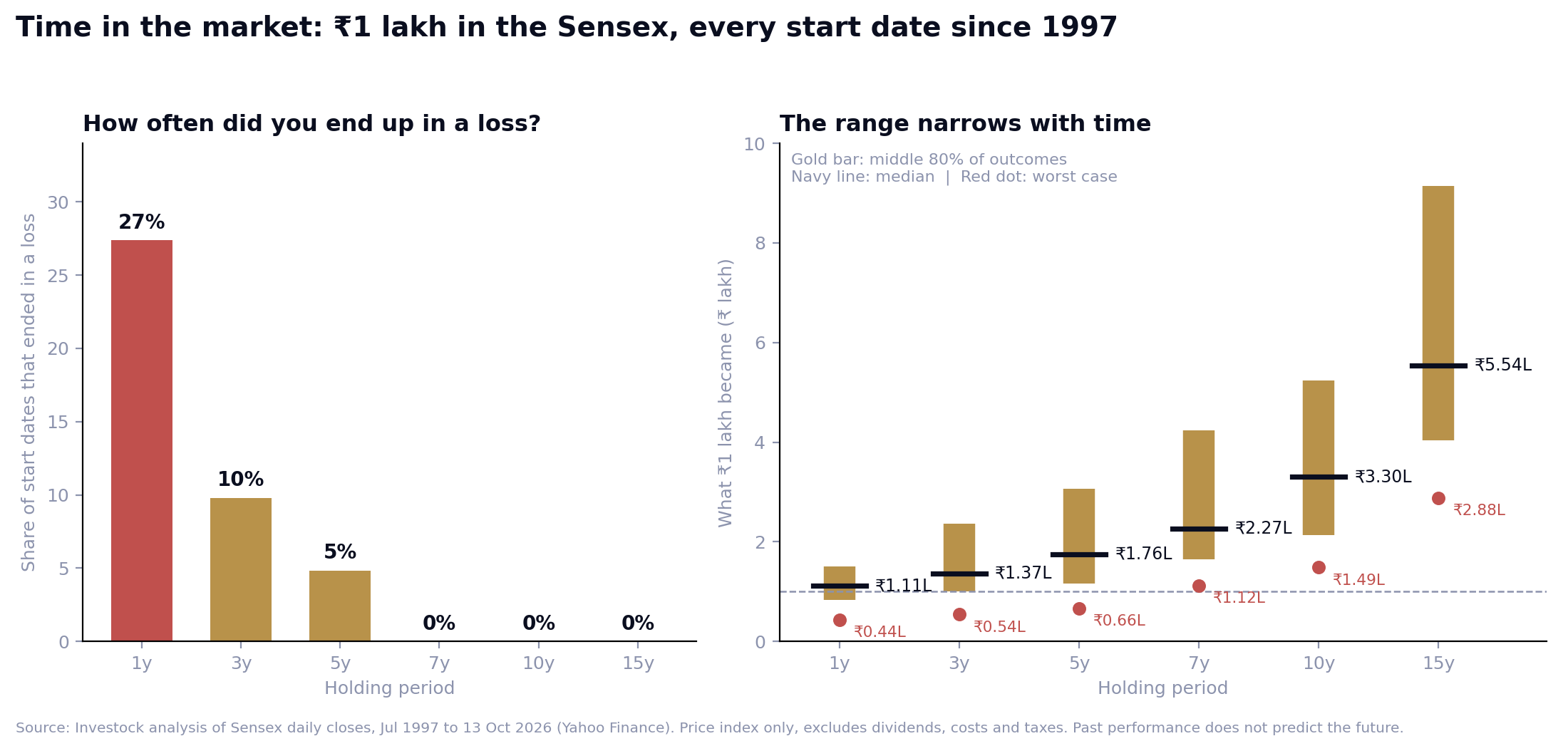
- Give it time,on every start date since 1997, ₹1 lakh in the Sensex ended lower after one year 27% of the time, after five years 5% of the time, and never after seven years or more.
- Follow a rulebook,decide your entry day, quantity and exit before the market moves, so that a scary headline cannot decide for you. Most people who start investing with ₹1 lakh fail at this step, not at picking stocks.
What to do after you buy: rebalancing and exits
Buying the basket is the start, not the finish. A model portfolio stays useful only if you maintain it with the same rules you began with:
- Follow the exit rule, not the headline,every position had an exit decided before you entered. When it triggers, you act, regardless of how you feel about the stock that day.
- Rebalance on a schedule,as prices move, weights drift. A periodic review trims what has grown too large and tops up what has shrunk, so no single stock quietly takes over your account.
- Replace, do not just remove,when a stock exits on its rule, the slot is usually filled by the next name the screen throws up, keeping the basket near its target number of positions.
- Resist the urge to tinker,the hardest part is doing nothing between signals. Most of the damage to small accounts comes from overriding the rulebook during a scary week.
This is why a model portfolio is a framework rather than a one-off purchase. The rules carry you through the periods when emotion would otherwise take the wheel.
Common mistakes when investing your first ₹1 lakh
The same few errors show up again and again in small accounts. A rulebook exists mainly to stop these:
- Too many tiny positions,twenty stocks of ₹5,000 each means flat charges eat a bigger share of every trade, and you cannot track them all.
- All-in on one idea,putting a third of the money in a single stock turns one bad call into a serious dent.
- Buying after a big run,chasing a stock that has already doubled, then panic-selling when it dips.
- No exit plan,entering with a target but no rule for when to leave, so the decision gets made in fear.
- Checking prices daily,which turns a long-term plan into a stream of short-term temptations to trade.
How much can ₹1 lakh grow? A note on expectations
It is natural to want a number. The honest answer is that nobody can tell you in advance, and anyone who promises a fixed return is a warning sign, not a tip. What history can offer is context, not a forecast.
As the holding-period chart above shows, ₹1 lakh placed in the Sensex on any start date since 1997 ended lower after one year about 27% of the time, and that share fell the longer the money stayed invested, reaching zero at seven years or more in that sample. That is the past, measured on an index, excluding dividends and costs. It is not a promise about any portfolio, stock or future period. Markets can and do fall, and you can lose money. Treat ₹1 lakh as money you can leave invested for years, size it so a bad spell does not force you to sell, and judge the process by whether you followed the rules, not by any single month.
How the Investock Model Portfolio works
The Investock Model Portfolio is built around exactly these steps, and you can start with ₹1 lakh:
- Three tiers: Low, Medium or High, from larger, steadier companies to faster-moving ones. The tier is locked for 6 months.
- Momentum screening picks the stocks, with equal weights so no single stock dominates.
- Exact quantity for your fund, so you know what to buy.
- Monday entries, one fixed day a week.
- An exit rule on every position, set before entry.
Every position comes with its quantity, entry day and exit rule, so you know all three before you place the order. You place the trades in your own account. Investock provides SEBI-registered research and never handles your money.
Related reading
- Position sizing for small accounts: how much to put in one stock
- Momentum investing in India: what DMart shows about winners, rules and exits
Frequently asked questions
What is a model portfolio?
A rules-based set of stocks with the quantity, entry day and exit rule decided in advance. Investock's model portfolio gives you the stock, the exact quantity for your fund and the entry day.
How much money do I need to start?
You can start the Investock Model Portfolio with ₹1 lakh. That is enough for about ten positions of ₹10,000 each.
Is a model portfolio the same as a mutual fund?
No. A mutual fund pools your money and the fund manager buys the shares. With a model portfolio you place the trades yourself in your own account, and Investock never holds or manages your money.
Can I use a model portfolio alongside my existing shares?
Yes. Many investors track their existing holdings and a model portfolio together, and decide how much of the model to mirror. The model's rules only apply to the positions you actually take from it.
Does a model portfolio guarantee returns?
No. It provides research, structure and discipline, but all securities-market investments carry market risk and values can fall. SEBI registration does not assure any return.
How is it different from a smallcase or PMS?
A PMS manager trades on your behalf and needs about ₹50 lakh to start. A model portfolio keeps you in control of every trade and can begin near ₹1 lakh. You hold the shares yourself in both, but only in a model portfolio do you decide what to act on.
How often will I need to act?
With the Investock Model Portfolio, new entries happen on one fixed day a week, and you act on an exit only when a position's rule triggers. Between those, the plan is designed so you do not need to trade.
What if I have less than ₹1 lakh?
You can still invest, but with fewer positions the round-trip cost of each trade matters more, so spreading across ten names becomes harder. Many investors add to the portfolio over time until it reaches a comfortable number of positions.
Ready to see the quantity, entry day and exit rule for your ₹1 lakh? Explore the Investock Model Portfolio at investock.ai.
Sources
- Sensex start-date analysis, Jul 1997 to 13 Oct 2026: Investock analysis of daily closes (Yahoo Finance), price index only (see Blog_Day04_Start_With_1_Lakh).
- Random basket test and round-trip cost: Investock analysis (see Blog_Day03_Position_Sizing). Costs use Zerodha's published delivery charges.
- Investock Model Portfolio rules: investock.ai product description (tiers, 6-month lock, equal weights, Monday entries, exit rule).